Underfoot: Reading the Room Through Britain’s Old Dance Floors
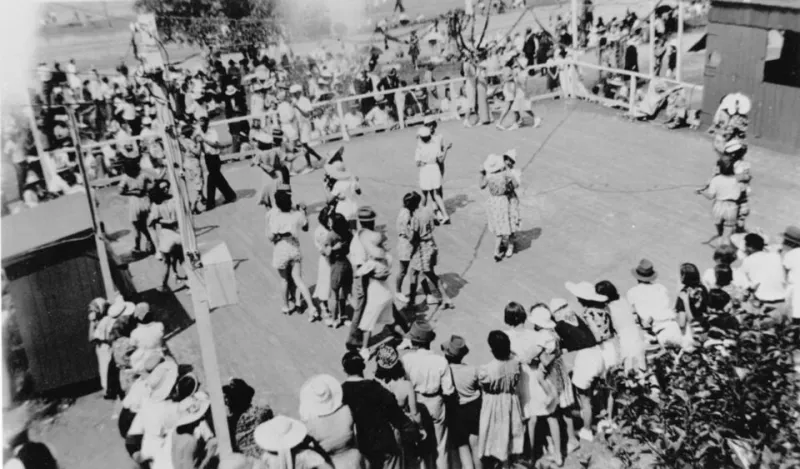
Photo: Unknown photographer, Public domain, via Wikimedia Commons
Before a workshop begins, I often crouch down and knock on the floor. Not scientifically. Just a small, superstitious hello. In a church hall in Fife it answers with a dry tap. In a Victorian school gymnasium in Salford it gives a hollow boom, like someone speaking from inside a wardrobe. In a regional theatre with a proper sprung floor, the reply is a low, forgiving thud that seems to say: go on, then.
Dancers talk a lot about space — height, width, sightlines, the black box, the outdoor pitch. We talk less about the surface under our feet, even though it is the first collaborator we meet and the last one to let us go. A floor can make a jump feel airborne or effortful. It can turn a quiet solo into a percussion piece. It can remember, in a very literal way, where people have stood before.
The sound before the step
Old floors are chatty. A loose board near the piano. A squeak that arrives exactly on the offbeat. The dull, rubbery sigh of a sports hall floor that has hosted thirty years of netball and school assemblies. None of this is background noise. It is information. If you are making work in a room with a noisy floor, you either choreograph with it or spend the whole rehearsal fighting it. I have done both, and the first is more interesting.
In a village hall in Dumfries and Galloway, a group of older dancers once taught me to use the boards as a metronome. The floor clicked under one heel. Without anyone saying so, the whole group began to land on that click. The phrase changed. It became more grounded, more communal. Nobody had planned it. The room had made an offer.
Sprung, but not always forgiving
A good sprung floor is a quiet luxury. It gives back some of the energy you put into it. It forgives bad landings and encourages risk. In the UK, proper sprung floors tend to live in theatres, dance studios and the occasional university sports centre. They are not evenly distributed. A touring company may spend a week on a beautiful stage in one city and the next morning teach in a community centre with a concrete base under thin vinyl. Dancers adjust. We always adjust. But it is worth noticing what the adjustment costs.
On unforgiving floors, the choreography often gets smaller. Jumps become steps. Drops become rolls. The body makes sensible, unconscious edits. That is not necessarily a failure. Some of the most precise dancing I have seen has happened on floors that refused to cushion anything. But it is a different dance. The floor has made a decision, and the dance has answered.
Church halls and the archaeology of use
Church halls are my favourite category of floor. They are usually wooden, usually uneven, and usually surrounded by the evidence of other activities: stacked chairs, a tea urn, a noticeboard advertising a bring-and-buy sale, a faint smell of floor polish and instant coffee. The floor has a history of use that is not only theatrical. It has held weddings, jumble sales, keep-fit classes, toddler groups, memorial lunches, polling stations and pantomimes. When you dance there, you are not the first event. You are one layer in a long, busy archaeology.
That can feel humbling or distracting, depending on the day. I have come to find it useful. It reminds me that dance is not a fragile thing that needs a pristine black box. It is one of the things people do in rooms that are already full of life. A squeaky board is not a flaw in the theatre. It is a reminder that the theatre is also a hall.
School gyms and the geometry of echo
School gyms are the opposite. They are loud, bright and hard. The walls bounce sound back at you. The floor is often marked with lines for games you do not understand. There is a particular echo in a school gym that makes every count-in sound slightly late. You clap to start a phrase and hear the clap return a half-second later, like a sarcastic assistant.
For community dance, gyms are often the only large indoor space available. They are practical, wipe-clean and booked by the hour. They are also strangely exposing. The overhead lights are unforgiving. The space has no wings, no dark corners. Everyone can see everyone. That can be a gift for a workshop, where the point is to be seen and to see. It can be less of a gift for a performance that wants a little mystery.
What the boards decide
I do not want to overstate this. A floor does not write the choreography. But it shapes the vocabulary. On a resonant floor, weight becomes audible. On a dead floor, weight becomes visual. On a slippery floor, turns become cautious. On a sticky floor, turns become dangerous. The dancer listens, adjusts, and the work changes by a few degrees. Over a long rehearsal period, those few degrees add up to a style.
This is why I like to arrive early. I want ten minutes alone with the floor before anyone else is in the room. I walk it. I jump on it. I lie on it. I listen to what it does when I push. It is not a technical survey, or not only that. It is a way of asking the room what kind of dance it is willing to support.
Listening underfoot
So here is a small field guide, no more than a habit. Before you begin, take off your shoes if the room allows. Walk the perimeter. Find the loose board. Find the spot that squeaks. Find the place where the floor gives. Notice where the sound goes when you land. Then let that knowledge sit in the background while you work.
The floor will not remember you in the way a person does. But it will carry the mark of your weight, the scuff of your turns, the particular vibration of your landing. And in a country full of old halls, school gyms and theatres that have seen better decades, that is a kind of company. The boards are not neutral. They are already dancing. Our job is to listen, and then to join in.