Two Lenses, One Dance: Choreographing for the Room and the Camera at Once
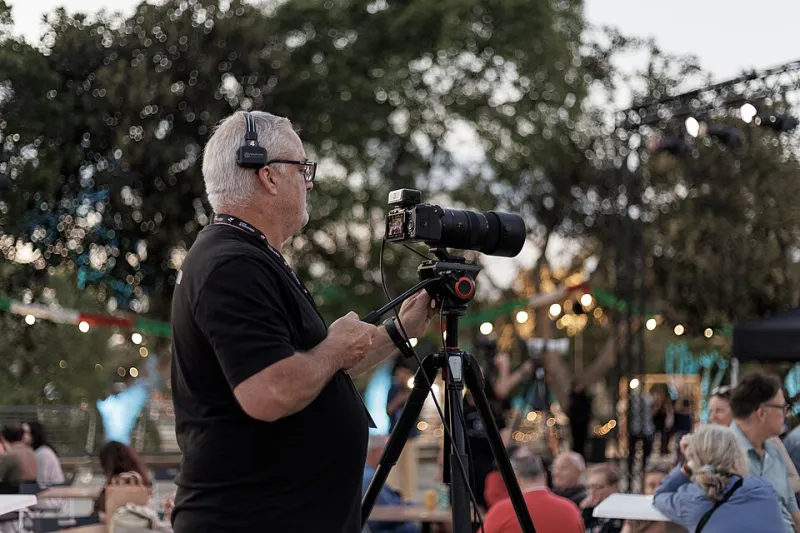
Photo: Godwin Borg, CC BY 4.0, via Wikimedia Commons
There is a moment in every filmed performance when a camera operator asks, politely, where they are allowed to stand. And there is a moment, roughly half a second later, when everybody in the room realises that nobody has decided.
That half-second is the whole problem in miniature. We have spent decades getting very good at making work for a room: sightlines, wing space, the temperature of an audience, the way a pause lands in row twelve. Then we point a lens at it and quietly hope the thing translates. It usually does. It rarely does as well as it could.
The second audience does not arrive at eight o'clock
A livestream audience is not an audience sitting behind the live one. It is a parallel room with its own acoustics, its own attention span and its own interruptions. A few hundred people watching from kitchens and bedrooms and one from a flat in Aberdeen with the heating ticking. Some of them will arrive late. Some will pause it to make tea, which the room they are watching cannot do. Some will watch it again on Thursday, which changes what the work is.
Every one of those people is a decision. The fact that we usually make those decisions at 4pm on the day of the show, in a technical rehearsal that is already running behind, is not a creative choice. It is a scheduling accident we have collectively agreed to call a style.
Three cameras and a question about where the dance actually lives
The wide shot is the honest shot and the least useful one. Dance seen in a full wide from the back of the stalls can look like a diagram of itself: two figures, a floor, some space, a long way away. It is accurate and it is inert. So you add a mid, and then a roaming operator on a stabiliser, and now you have cut the work into three different spatial arguments.
Which one is the dance? The choreography you made in the studio did not specify. A duet that is built for the diagonal reads one way in the wide and quite another in a close two-shot, where the space between two dancers stops being architecture and becomes a fact about their faces. Neither is wrong. But you have to choose, and choosing is choreographing.
The thing that helped us most was writing a shot list in the studio, in the same document as the choreographic notes, at the same time as the material was being made. Not a technical document — a phrase-by-phrase one. Here we want the whole floor. Here we want to lose the second dancer for four seconds and find them again. Here, do not cut, whatever you do, do not cut.
Latency, or the laugh that arrives late
A livestream runs somewhere between a third of a second and a second and a half behind the room. That sounds negligible until the first joke. The live audience laughs; the sound reaches the stream audience after the move has finished; they laugh then, in a wave that the performers cannot hear and the editor cannot fix.
You can treat that as a fault. Or you can treat it as a second acoustic, and mix for it. We ended up keeping a room microphone fairly high in the stream mix, not for the dialogue — there is not usually any — but because the sound of three hundred people breathing and shifting is information. It tells a viewer in a kitchen that they are in a room with other people. Take it out and the dance becomes a document.
The operator is an improviser whether you cast them or not
Good camera operators make compositional decisions in real time: when to hold, when to drift, when to let a dancer leave the frame and trust that they will come back. That is improvisation. The trouble is that we often cast it by accident, at the last minute, and then wonder why the stream feels like a different show.
If the operator is improvising, brief them like an improviser. Tell them what the work is about. Tell them which moments are load-bearing and which are disposable. Let them watch a run in the studio, not just a dress in the venue. The best note we ever gave was simply: at minute 22, do not follow her. Let her go.
Two light states, one rig
The eye and the sensor do not agree about darkness. A low-state section that reads as gorgeous, velvety gloom in the auditorium can arrive on a stream as a grey rectangle with some guesswork in it. Nobody wants to relight the show for a camera, and nobody wants the stream to look like a badly encoded memory either.
The compromise is planning. Ask for the camera's exposure limits before the plot is finalised. Ask where the high riser goes, or whether there is a jib, because floor-based work needs an angle from above or it will read as a puddle. And put a camera rehearsal in the schedule as a real session with real time in it, not as something that happens in the gaps while somebody else is focusing a special.
Budget it or lose it
A stream is not free. Three operators, a vision mix, an encoder, a line, a licence, someone to sit with the chat, and a fee for the person who has to make it all legible at midnight. If it is not in the budget at the R&D stage, it will be paid for out of the show, and the show will be what gets thinner.
And then decide honestly what it is for. Some companies stream to reach audiences who cannot travel. Some do it for the archive. Some do it because a funder asked. All three are legitimate, and all three require different versions of the work. An archive recording wants coverage and consistency. A live stream wants atmosphere and nerve. They are not the same edit, and pretending otherwise gets you a file that does neither job well.
The second audience is not the smaller one
We ended up preferring a single-camera, no-cut version for one date — one long, patient take, with all the waits and the walkarounds left in. It was, by any technical standard, the least impressive of the streams. It was also the only one that felt like being in the room.
That is the thing worth resisting: the assumption that the stream is the afterthought, the souvenir, the compromised version of the real event. It is another room. Choreograph it, staff it, pay for it, and rehearse it — and it stops being a recording of a dance and starts being one.