Five Things a Half-Full Room Tells You That a Sell-Out Never Will
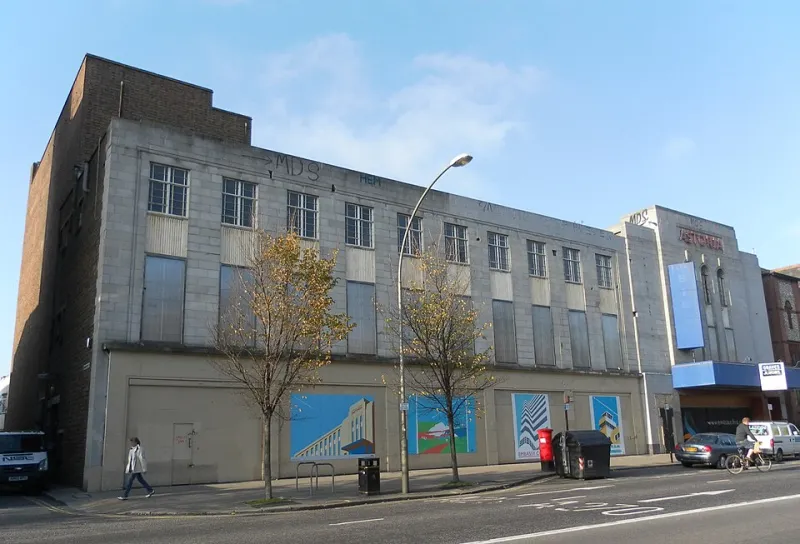
Photo: Hassocks5489, CC0, via Wikimedia Commons
There is a particular sound a half-full theatre makes. Not silence — something better than silence. You can hear the seats. You can hear the extractor fan above the stage. You can hear your own breath before the first lift, and you can hear 94 people deciding, individually, to stay with you.
Last month we played a 380-seat house in the north of England on a wet Tuesday. The house count went up on the board in the wing: 94, plus 12 comps. Someone had sold a block of 40 in row F and then the block had come apart into scattered singles, which is somehow worse to look at than an entirely empty row. At the interval I stood at the back of the circle and counted the taken aisle seats, the way you do.
I have been thinking since then about what that room taught us. Not in the gritted-teeth way, and not in the 'every audience is a good audience' way that gets said at the post-show talk, but actually. A small house is not a diluted version of a full one. It is a different choreographic condition, with its own physics and its own demands.
1. Ninety-four people stop being an audience and start being people
At 300, a house is weather. It is warmth, it is noise, it is a tide you can swim in and you never quite know what is happening inside it. At 94, the tide breaks up into individuals and you can see them. There is the man in row C who checks his watch at minute twelve — and then, crucially, stops checking it. There is the pair of women in the circle who come in late, sit at the end of a row, and spend the first four minutes taking off their coats in that elaborate folding way. There is the single figure in the front row who laughs at the line we did not know was funny.
You learn more about your own work in one night in a small house than in a month of full ones. A full house forgives a sag in the middle; it is too busy being a crowd. A half-full house notices. That is not cruelty — it is attention with a face on it.
2. Comedy needs a crowd, but timing only needs a witness
The laugh is the thing that changes most. In a busy room, the laugh is a wave: it arrives after the line, rolls, and carries you to the next thing. In a sparse room you hear the actual machinery — the inhale, the half-second of hesitation, the decision. Our timing shifted within about six minutes. Pauses we had been holding at two seconds contracted to something nearer one, because we could suddenly hear what the room was doing with them.
There is a trap here, and we walked into it on the second night. When the laugh does not arrive, the instinct is to go and get it: push the shoulder, widen the eyes, sell it. Do that and you are doing a different, worse show for a room that never asked for it. The half-full house takes the laugh away as a metric, and you find out whether the comedy lives in the writing of the movement or only in the response.
3. Borrowed stamina is not the same as generated stamina
A loud room gives you fuel. You can run on it through the third quarter of a 55-minute work, and I had not fully understood how much I had been doing that until there was nothing to run on. The piece we were touring has a long, low, slow section around minute 38 which, in a full house, is carried along on a kind of ambient attention. In front of 94 people it had to be carried by us, and it turned out our tempo had been drifting there for months.
That is a useful humiliation. It also produces a temptation: to over-dance, to give the sparse room more than it needs, as though volume of effort could make up for volume of people. It cannot. The better answer was to do less, slower, with more precision — to trust the thing rather than top it up.
4. The empty seats are inside the choreography whether you like it or not
Nobody reblocks at 7:28pm. You walk out and the gaps are where they are — the two-thirds-empty row F, the whole back three rows of the circle, that lone seat in the middle of the stalls that looks, from the stage, like a hole in the floor. You have to decide in the first thirty seconds whether the work is going to acknowledge them or not.
Some pieces want density and cannot survive being read across negative space; they need the wall of bodies. Others — and this one, thankfully — get a little more air. The duet in the second half felt more private and more strange in a room with visible gaps, and I do not think that was our imagination. The distance between people is part of what an audience reads. Sometimes there is more of it to read.
5. The full house is a press-release problem, not an artistic one
Here is the uncomfortable part. The full house is a metric invented by people who need a number for the funding report, the board pack and the season brochure. 'Sold out' is a marketing phrase with a very good publicist. It is not a description of whether the work landed.
That Tuesday, 94 people chose to leave their houses on a wet night in a city where the parking is £6.50 and the bus replacement service was running. That is not a weakened audience. That is a committed one. Afterwards a woman in her sixties told me the slow duet reminded her of her sister, and that she had never seen contemporary dance before and had assumed it would be 'a bit much'. She stayed for the whole conversation. If you had asked me at 7:15pm what a good night looked like, I would have said a fuller room. By ten o'clock I would have said exactly what we got.
What to do with it afterwards
Two practical things. First, do not apologise from the stage. 'Thanks for coming out on a Tuesday' delivered in the wrong tone is an apology, and it tells the people who did come that they are a consolation prize. Second, keep the post-show conversation. In a small house the talk is not a marketing add-on; the room has already been a conversation for seventy minutes, so it may as well carry on.
We came home with eleven pages of notes and a slightly different show. Not because we had failed to fill the room, but because for once we could see it properly.