Radiator Hiss and Wet Coats: Rehearsing Into the Dark
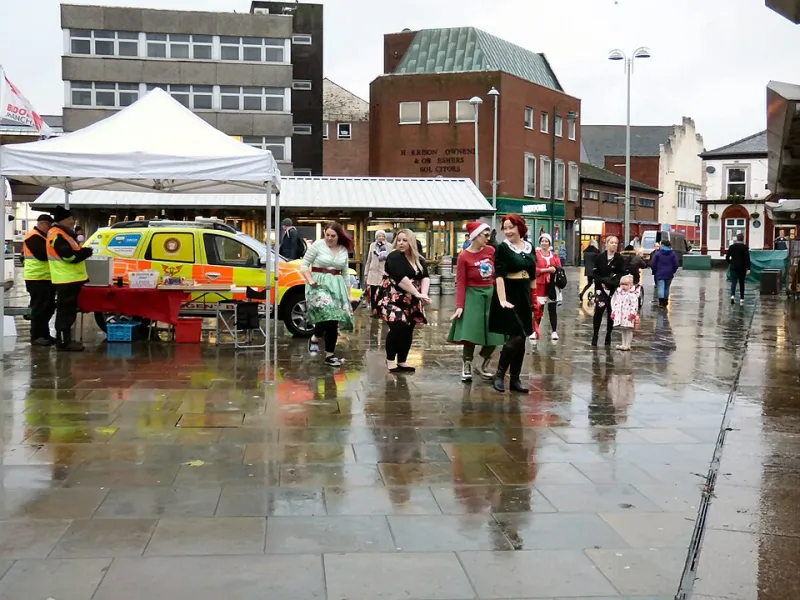
Photo: Gerald England , CC BY-SA 2.0, via Wikimedia Commons
By the time the clocks go back, the studio has usually told you what kind of day it is. The window in the corner is running with condensation. Somebody’s coat is dripping onto the floor by the radiator. The first person through the door says, ‘It’s grim out there,’ and everyone nods, because the room has already brought the weather in with them.
That is not a complaint. It is a fact of rehearsal. In a British autumn, the weather is not a backdrop you leave at the entrance. It is a condition of the work: in the temperature of the floor, the weight of the air, the low grey light that makes the mirrors feel slightly wrong, and the sound of rain on a flat roof that arrives without warning and then refuses to leave.
The room arrives with its own forecast
Most dance studios are not sealed boxes. They are old buildings with new purposes, and they leak information. A Victorian window frame lets in a draught that finds the back of your neck during the slowest section. A ceiling heater clicks on halfway through a run and changes the whole atmosphere. The floor by the fire exit is colder than the floor by the piano, and dancers know this within minutes. They gravitate without being asked.
Venue managers know it too. They talk about the building as if it were a colleague with habits: the radiator that takes an hour to wake up, the extractor fan that cannot be used at the same time as the kettle, the door that swells in wet weather and needs a shoulder. None of this is glamorous. All of it is choreographic, in the sense that it shapes where people stand, how they move, when they pause and what they can hear.
Warm-up is a negotiation
In summer, a warm-up can be almost ceremonial: a slow unfolding, a chat, a stretch. In November, it is a negotiation with the room. Hands take longer to feel like hands. Feet want more time on the floor. The first tendu of the day can feel like a question rather than a statement. Dancers arrive early not because they are unusually virtuous but because the building requires it.
A practical adjustment is to begin with contact rather than extension. Rolling on the floor, leaning into a partner’s weight, walking the perimeter of the room, sitting on the floor and breathing — these are not lesser warm-ups. They are ways of asking the room what it is offering today. If the radiator is clanking, you find out whether the sound can be absorbed into the work or whether it needs to be fixed before anyone can concentrate. If the floor is cold, you spend longer on it before asking for jumps. It is not mollycoddling. It is scheduling the body’s actual conditions into the rehearsal.
Floor, draught and the small politics of heat
British studios often run on a compromise: enough heat to keep the body working, not so much that the air goes stale. In autumn, that compromise gets tested. Open a window for ventilation and the draught crosses the floor at ankle height. Close it and the room becomes fuggy by the second hour. Dancers layer up, strip off, layer up again. Somebody puts a jumper over the radiator and is politely told not to. Somebody else moves a fan and changes the airflow for everyone.
These small decisions are worth naming. They are not housekeeping; they are part of the rehearsal culture. A company that talks about the radiator is a company that is paying attention to the room. A choreographer who notices that one dancer is shivering in the corner and moves the warm-up there is doing the same work as one who notices a missed count. The weather makes the invisible visible: who is comfortable, who is not, whose body is being asked to adapt without saying so.
The sound of the outside
Rain on a studio roof is one of the most useful and most irritating sounds in British rehearsal. Useful because it is rhythm without a conductor. Irritating because it arrives midway through a quiet phrase and makes everyone laugh. The temptation is to drown it out with music. The better move, sometimes, is to let it in for a minute. Listen to what it does to the timing. Notice whether the dancers speed up, soften, or start to play with the noise rather than against it.
Autumn also brings its own outside sounds: wind in a ventilation shaft, the scrape of a bin lorry, the early dark that makes the street outside feel closer. These are not distractions to be eliminated. They are the acoustic texture of making work in a real building in a real place. A rehearsal that can survive a sudden downpour is a rehearsal that is learning something about resilience.
Scheduling around the light
Low light changes the body’s sense of space. In a studio with big windows, a grey afternoon can make the far corner feel further away. In a basement studio, the fluorescent strip is the only weather there is. Dancers adjust their spatial awareness without comment, but the work absorbs it. A phrase that felt open and generous in September can feel cautious and inward in November.
This is why it helps to schedule the day in relation to the light rather than pretending it is neutral. Put the detailed, close work in the morning if the room is brightest then. Use the late afternoon for runs, when the body is warmer and the brain is more willing to let go. If the studio has a blackout, use it. If it does not, stop fighting the window. The weather is already in the room. The question is whether the rehearsal acknowledges it.
What the weather teaches the work
Making dance in a British autumn is a lesson in collaboration with things you cannot control. The room is too hot, then too cold. The rain is too loud, then suddenly gone. The floor is unforgiving by the door and generous by the mirror. None of this is ideal. All of it is real.
And real conditions can be useful. They keep a company honest about what a body needs. They make the warm-up less abstract. They turn the radiator into a metronome and the wet coat into a reminder that everyone arrived from somewhere else. The weather does not have to be an inconvenience. Treated with a bit of curiosity, it becomes another collaborator in the room — one that does not take notes, but definitely has opinions.
So leave the coat where it is for a minute. Listen to the radiator. Let the rain have its say. Then get back to the work, warmer than before.