The Twenty-Minute Score: Who Choreographs the Theatre Interval?
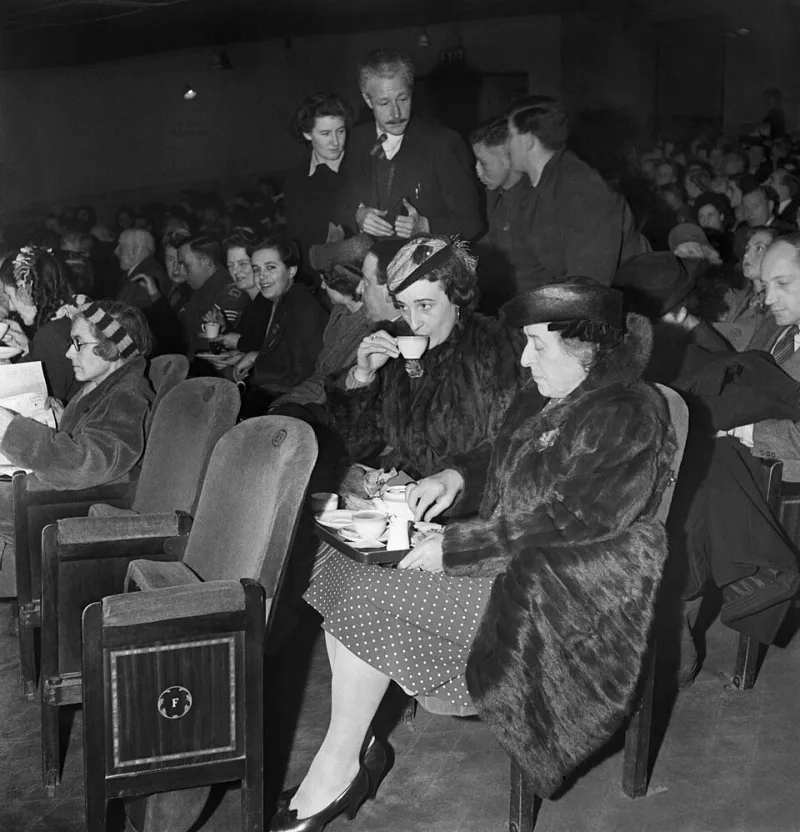
Photo: Ministry of Information Photo Division Photographer, Public domain, via Wikimedia Commons
There is a piece of choreography performed in British theatres every night of the week, and no one is credited for it. It lasts roughly twenty minutes. It has a beginning, a middle and a slightly panicked end. It involves hundreds of people moving through confined space in a loose but surprisingly consistent pattern, and it changes how the audience feels about everything that follows.
We call it the interval and we treat it as dead space.
The shape of the thing
Watch it from the back of a stalls bar at a mid-scale touring house and the structure is almost classical. First the surge: the instant the lights come up, a third of the auditorium stands at once, and the exits become a bottleneck. Then the dispersal — the bar queue forming its familiar switchback, the pre-order table, the toilet queue doubling back past the merchandise. Then the plateau, where people stand with a glass and say the thing they actually think.
Then the bell. And then the return, which is the part nobody plans for: the slow trickle back into seats, the shuffling past knees, the coats on laps, the low hum that doesn't quite settle before the second half begins.
Twenty minutes is the convention. Some venues run fifteen, some twenty-five. Either way, the length is almost always decided by bar revenue and operational habit rather than by dramaturgy — which is odd, given that it sits inside the work.
The verdict is part of the performance
Stand in a stairwell at Sadler's Wells or The Lowry during an interval and you will hear criticism happening in real time. Not the considered kind. The immediate kind: I didn't get the bit with the chairs. She's incredible, though. Is this the one your sister saw?
For a dance-maker this is unnerving and useful in equal measure. The interval is where the audience assembles its own reading of what it has just seen, out loud, with a drink in hand. It is the only moment in the evening when they are actively making the work rather than receiving it. That's not a distraction from the piece. That's the piece's argument becoming social.
And it is fragile. Whatever consensus forms in that queue — that it was beautiful but long, that it was baffling but worth it — will walk back into the auditorium with them. The second half is watched by a slightly different audience than the first.
Where treating it as a score goes wrong
There is an obvious temptation here, and it produces a particular kind of mess. Programmed interval content — a lone performer in the foyer, an installation on the stairs, a QR code that asks you to reflect — usually fails for the same reason: it mistakes the interval for stage time.
The interval is not a slot to be filled. It is a decompression chamber. People need to stand up, talk nonsense, find a loo, buy a drink, and let their attention drop so it can come back. Fill it with more work and you get a room of people being polite at something they'd rather not be doing while their bladder waits.
The distinction is between shaping the interval and colonising it. Shape is: how long it is, what people hear, how they come back. Colonisation is: an extra scene nobody asked for.
Four practical levers
Length as dramaturgy. A ninety-minute first half and a twenty-minute interval and a forty-minute second half is a shape, and it's a punishing one. If the first half is dense, allow a longer break. If the piece is a slow burn, consider whether the interval interrupts the burn — some work genuinely wants no break at all, and the honest question is whether the interval exists for the work or for the bar.
Sound that doesn't stop dead. A hard cut to house music at the interval tells an audience the piece is over. A sound designer who lets a low bed bleed into the foyer, or who leaves the auditorium in near-silence, gives people a way back in before they've found their seats. It's a small thing. It's also the difference between a snap and a hinge.
The return as a cue. Most second halves start with a blackout and a fresh cue, which assumes everyone is ready. They aren't. A held image, a repeated phrase from the first half, a slow fade-in of light over ninety seconds — these give a returning audience something to land on. Re-entry is choreography. It should have counts.
The building is the set. Every access requirement in the interval is a movement problem: the stairs, the queue, the crowded corridor, the accessible loo that's three minutes further away than the main one. Relaxed performances, dementia-friendly performances and anything with a young audience need an interval designed from the outside in. If the route back to the seat is stressful, the second half starts with a stressed audience.
What the interval tells you about attention
Here's the thing I keep coming back to. We talk about holding attention as if it's a skill of the maker — the grip of a phrase, the pull of a image, the refusal to let go. But attention doesn't work like a grip. It works like breathing. It needs the out-breath.
The interval is the out-breath, institutionalised. Twenty minutes where nobody is asking anything of you except that you come back. Treat that as dead space and you'll spend the second half re-earning an audience you already had. Treat it as part of the piece — as a room you've built, a length you've chosen, a return you've staged — and the whole evening gets a little more honest.
Nobody will ever put the interval in the programme. But it's in the work. It always was.