The City Already Has a Tempo: Dancing with Found Sound
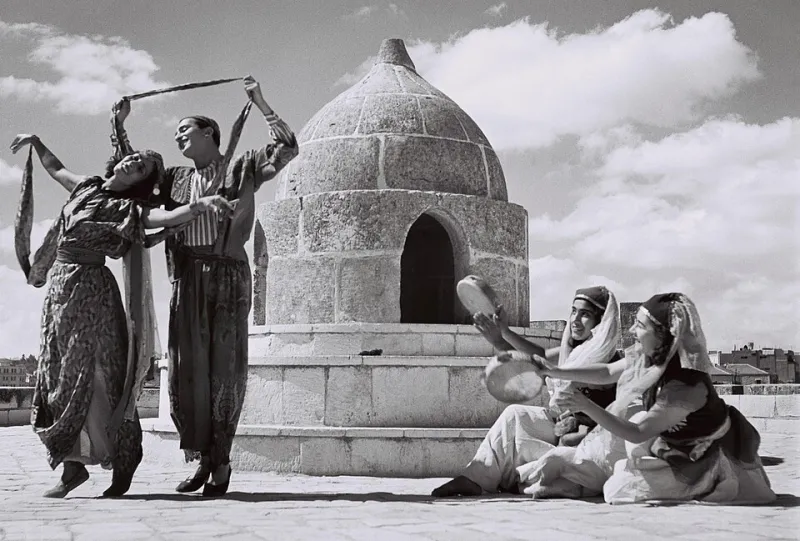
Photo: Zoltan Kluger / Adam Cuerden, Public domain, via Wikimedia Commons
Before I make a movement phrase in a public space, I try to stand still for five minutes. Not in a performative way. No headphones, no phone in hand, no useful purpose. Just listening.
It is never quiet. The UK street is a restless composer. A bus sighs at the lights. A seagull shouts over a coastal high street. A shop radio leaks a half-familiar chorus through an open door. Rain hits an awning with a rhythm that is almost a beat, then stops being one. These sounds are not a backdrop to site-specific dance. They are collaborators with their own agenda.
Listen before you move
The first practical step is to stop treating noise as interference. That is easier said than done. Most of us are trained to tune out the city. We walk through it with a internal soundtrack, a podcast, a plan. But found sound work asks for a different kind of attention: open, patient and a little undefended.
I make a listening map before I make a movement map. Where are the loudest points? Where does the sound drop away? Is there a corner that catches footsteps, a wall that bounces voices, a doorway that hums? I note the changing of the traffic lights, the school run, the bin lorry, the point when the shops close. These are cues, even if nobody has written them down.
A phone recording is useful, but it is not the whole story. The microphone hears differently from the body. It flattens distance and exaggerates close sounds. So I record, then I return without recording. The body remembers what the ear misses.
Traffic as a metronome you cannot control
Traffic gives a pulse, but it is not a reliable one. That is the point. A pedestrian crossing beeps at a fixed interval, then stops. A bus accelerates, brakes, idles. A cyclist passes with a soft hiss. The rhythm is regular enough to lean on and irregular enough to keep you awake.
In a site-specific score, I might use the traffic light cycle as a rough structure. The dancers have a phrase that lasts one crossing cycle. If the lights change early, the phrase changes. If a lorry drowns out the cue, the group has to watch instead of listen. This is not chaos. It is a duet with an unreliable partner.
Found sound changes timing because it refuses to stay in the rehearsal room. You cannot count the city in eights. You can only agree to meet it. A phrase that feels spacious in the studio can feel rushed next to a busy road. A slow lift that reads as tender inside can read as stubborn beside a bus stop. The same movement has a different weight when it has to compete, or consciously not compete, with the world around it.
Small weather, large shifts
Rain on awnings is one of the great overlooked scores. It is percussive, uneven and strangely intimate. It gathers people under cover. It changes the speed of a high street. It turns a wide pavement into a series of small shelters.
I have used rain as a cue for entrances and exits: a dancer steps out when the drumming on the awning gets heavier, then retreats when it softens. The audience's attention shifts too. They are not only watching the body; they are hearing the roof above them. The dance becomes a way of noticing where you are standing.
Seagulls are another matter. In coastal towns they are not background. They are protagonists. Their calls cut across everything — shrill, comic, occasionally threatening. A dancer cannot pretend they are not there. The best response is not to raise the volume but to let the bird interrupt. An interruption is a compositional event. It changes focus, breath and the next decision.
Shop radios and accidental harmony
Shop radios are a gift and a hazard. A charity shop might be playing a ballad from three decades ago. A barber might have a talk station on. A phone shop might be leaking a bassline through glass. The result is not a playlist. It is a collision of tempos and moods that no one curated.
In one scratch score, I asked dancers to find a movement quality that matched the sound nearest to them, then pass it on when the sound changed. The piece became a chain of small translations: a slow ballad produced a sway; a football commentary produced a sudden, alert shift of weight; a jingle produced a phrase that was almost embarrassingly cheerful. The audience started listening to the street as much as watching the dancers.
This is where found sound becomes more than atmosphere. It becomes a way of distributing attention. The viewer cannot settle into one focus. They are pulled between the body, the bus, the radio, the rain. That can be thrilling. It can also be exhausting. A good score shapes the pull.
Cue sheets for an unscripted city
A practical found-sound score needs to be flexible. I write cue sheets with categories rather than exact sounds: 'traffic surge', 'shop radio', 'footsteps close', 'weather change', 'unexpected voice'. Each category has a set of possible responses: hold, repeat, displace, soften, stop. The dancers learn the categories, not a fixed sequence.
This keeps the work alive. It also keeps it honest. If the street is quiet, the dance should not pretend otherwise. If a bin lorry arrives during the tender duet, the dancers have to decide whether to ride it, pause, or let the moment dissolve. Those decisions are the choreography.
There are ethics to consider too. Not every public sound should be recorded or amplified. People are not content. A site-specific work should be careful about filming, about volume, about who gets to be heard. Found sound is not a free resource; it is a shared environment.
The audience hears differently
When a dance is made with the street, the audience becomes a listening body. They stand differently. They look around. They notice the awning, the gutter, the bus that arrives at the wrong moment. The work does not ask them to ignore the world. It asks them to include it.
That is the quiet argument for found sound. It is not about adding noise to dance. It is about accepting that the noise is already there, with its own timing and weight. The choreographer's job is not to control it. It is to listen, respond and make a frame in which other people can listen too.
The city already has a tempo. We may as well dance with it.