What the Glass Decides: Choreography, Reflection and the Rehearsal Room
In a church hall in Leeds, the mirror arrives on castors. It is wheeled out for the community ballet class, then turned to the wall for the contemporary workshop that follows. Nobody announces this. The room simply changes its mind about what it is for. That small piece of theatre — glass facing out, glass facing away — says more about dance training than many mission statements.
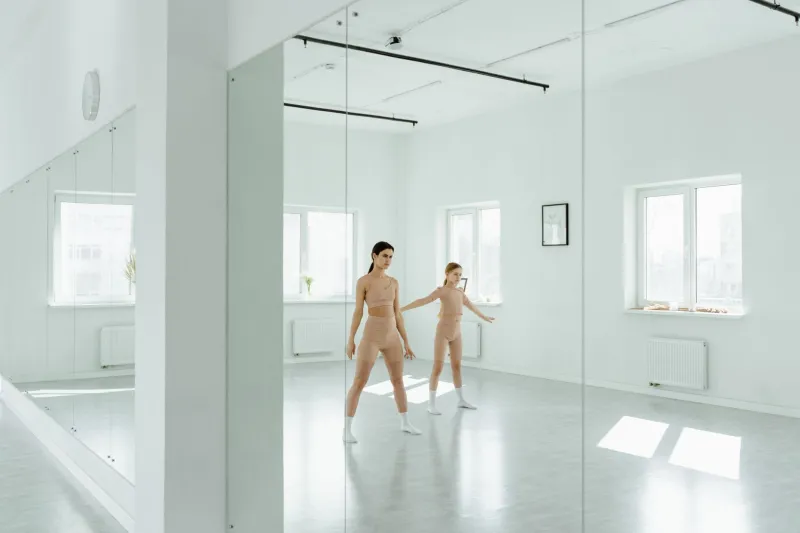
Most of us have rehearsed in rooms where the mirror is treated as neutral equipment, like a barre or a stack of mats. But a mirror is not a passive surface. It edits. It frames. It rewards certain lines and quietly penalises others. In UK studio culture, where space is often shared, booked by the hour and shaped by whatever came before, the mirror can feel like the most authoritative thing in the room. The question is whether we are using it, or it is using us.
The front wall has a vote
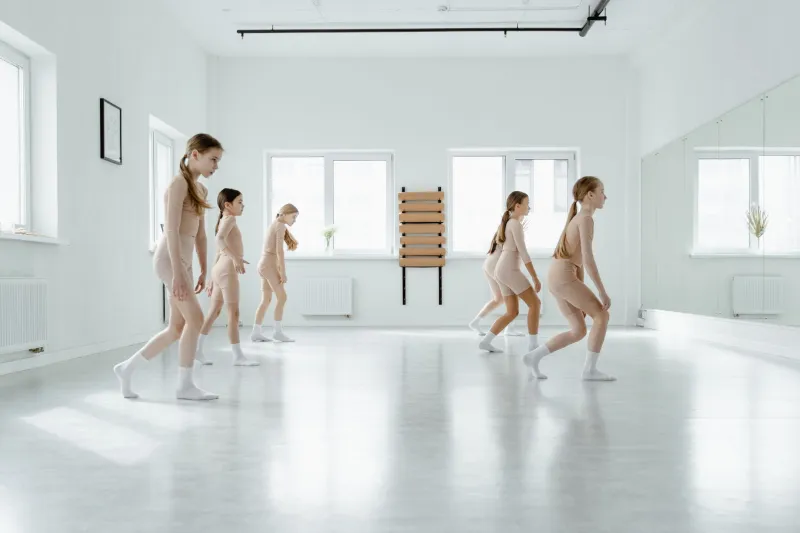
Walk into a mirrored studio and notice where people stand. The front wall pulls focus. Dancers drift towards it, teachers teach towards it, and choreography begins to arrange itself for the view. A phrase that feels spacious in the body can look fussy in reflection; a movement that travels beautifully through space can seem awkward when cropped by the glass. Neither version is the truth. But the mirror makes its version feel urgent.
In rehearsal, this can be useful. Reflection exposes habits: a collapsed rib, a rushed transition, a repeated pathway that has become invisible from the inside. For teaching, it can help a group synchronise without endless verbal description. But it also encourages a particular kind of looking — the outside-in glance, the quick check, the silent correction. Over time, that glance can become the default. Dancers start to choreograph for the image before they have tested the sensation.
I have seen this most clearly in studios with a full mirrored wall and a hard, flat floor. The room says: display. The work becomes cleaner, more frontal, more aware of its own outline. Move the same session to a community hall with a scuffed parquet floor and no glass at all, and the priorities shift. Weight comes back. Partners listen differently. The back of the space starts to matter.
When the mirror teaches
Teaching habits are where the mirror really settles in. A common instruction is to watch yourself in the reflection while marking a phrase. It sounds practical, and sometimes it is. But it can also split attention at exactly the moment a dancer needs to feel where the movement is going. The eyes go out, the body follows the picture, and the inner sense of the phrase gets downgraded to background noise.
There is a body-image dimension here too, and it is not abstract. Mirrored studios can turn a warm-up into an audit. Dancers compare proportions, lines, the shape of a leg in second position. The glass does not create those anxieties on its own, but it gives them a surface to gather on. In a culture that already asks performers to be highly self-aware, the mirror can become a critic that never takes a coffee break.
This is not an argument for smashing the glass. It is an argument for noticing what it is doing. A teacher who says 'use the mirror to check the shape, then close your eyes and repeat it' is already doing this work. So is the choreographer who asks dancers to learn a phrase facing away from the front wall, then turn and compare. The mirror becomes a tool with an on-off switch, not a permanent judge.
Rooms without reflection
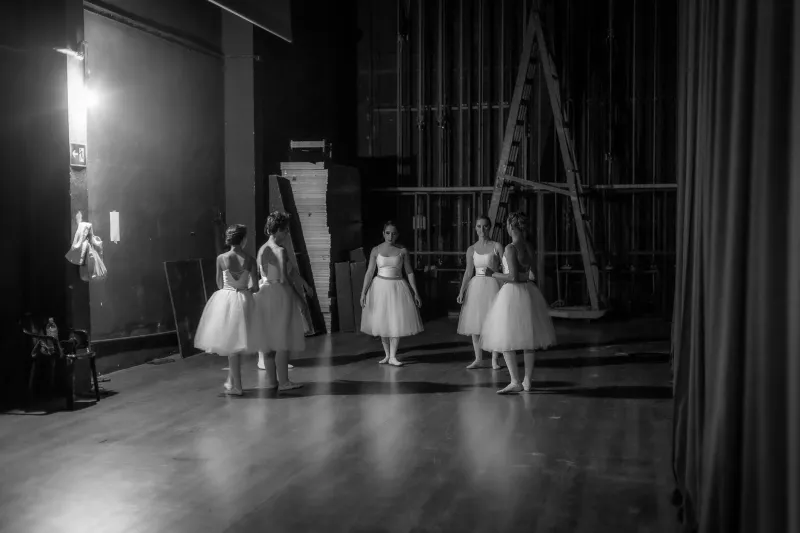
Some of the most interesting rehearsal conditions in the UK are the ones without a mirror at all. Rural touring often lands companies in village halls, sports pavilions and church rooms where the only reflection is a dark window after dusk. Site-specific work does the same. You cannot check a phrase against a mirror when the performance space is a courtyard, a corridor or a patch of grass.
At first, this can feel like a loss. Dancers who are used to visual feedback may reach for a phone to film a run. That is fine — video is a different tool, and it can be reviewed with more distance than a live reflection. But there is something valuable about the disorientation of no mirror. The body has to rely on proprioception, breath, sound and the eyes of trusted others. Choreography starts to organise itself around feeling and relationship rather than front-facing polish.
In a hall in the Scottish Borders, I once watched a group rehearse a simple walking pattern with no mirror and no clock. The phrase got slower. People began to listen to each other's footfalls. The work became less about what it looked like from the front and more about what it was like to be inside it. That is not automatically better. But it is different, and the difference is worth choosing deliberately.
A more deliberate glass
So what does an intentional relationship with the mirror look like? It might mean covering it for the first hour of a rehearsal and uncovering it for a specific check. It might mean using only a corner of the glass, so the room does not become a proscenium. It might mean filming a run and watching it back together, rather than letting everyone privately audit themselves in real time. It might mean asking a simple question before the session starts: what is the mirror for today?
For teachers, it could mean naming the difference between looking for information and looking for approval. For choreographers, it could mean noticing when a phrase has been quietly rearranged for the front wall. For dancers, it could mean practising the radical act of turning away from the glass and trusting the score.
The studio mirror is not neutral. It has a vote. But it does not have to chair the meeting. In a room shaped by light, floor, sound and other people, the glass is only one collaborator among many. The work gets richer when we decide, consciously, when to look and when to let the body lead.