Before the Cue: The Choreography of the Backstage Wing
Most audience members think the performance starts when the lights come up. Fair enough: that is the contract. But anyone who has stood in the wings knows there is a parallel performance already underway — quiet, practical, sometimes chaotic — and it has its own choreography.
The space just off
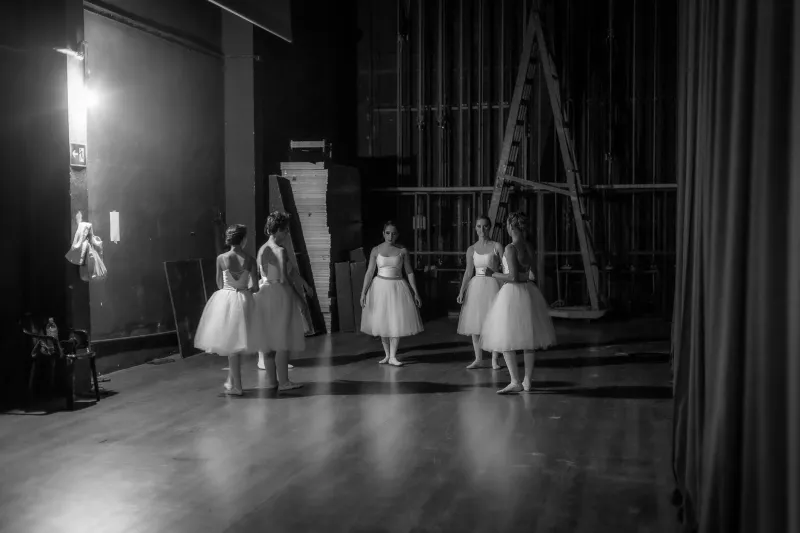
The wing is an odd piece of architecture. It is a place of arrival and delay, a narrow strip where the public world of the auditorium meets the private world of the rehearsal room. In older UK theatres the wing can be cramped enough that two dancers passing each other must turn sideways. In a rural village hall it might be a gap between two black tabs, a corridor beside the kitchen, or a line of chairs behind a folding screen. In a sports hall there may be no wing at all — just a taped line on the floor and a stage manager holding a clipboard.
Whatever its shape, the wing is never empty, even when it looks empty. It holds breath, last-minute notes, half-finished jokes, the smell of rosin and hairspray, the soft percussion of feet marking a phrase. It is a rehearsal room with a very short lease.
Warming up in public, almost
In the last three minutes before an entrance, dancers do what dancers do: they prepare. Someone shakes out a calf. Someone else rolls down through the spine and back up. A hand finds a partner’s shoulder for a quiet balance. There is often a tendu, a small circle of the ankle, a flex and point, a tiny run of steps executed at quarter scale.
This is not the formal warm-up from the studio. It is maintenance. It is the body checking its own systems before the door opens. On tour, this ritual adapts to the venue. In a theatre with a proper crossover, you might see a dancer warming up while walking the length of the back wall. In a community hall, you might see the same dancer warming up in a corridor while a local volunteer asks if the tea urn is in the way.
The casualness is deceptive. These small actions are part of the performance’s preparation, and they leak into the first moment the audience sees. A dancer who enters with settled breath and a clear focus carries a different quality from one who enters still catching up with the cue.
Marking, not wasting
Marking is one of the wing’s most useful languages. Dancers run phrases with minimal effort — hands tracing the shape of a lift, feet suggesting a jump, eyes finding the spot where a turn will land. It looks like half-dancing, but it is really a form of rehearsal memory. The body is reminding itself of the map.
In the wing, marking is also a social negotiation. Two dancers might mark a partnering sequence together, whispering counts. A stage manager might mark a cue with a raised hand. The lighting designer might be checking a sightline. The choreography of the wing includes all of this: the small gestures of coordination that keep the show moving.
On a recent rural tour, I watched a dancer mark an entire entrance phrase using only her fingertips against the palm of her other hand. She was not wasting energy. She was keeping the shape alive until the stage was ready for it.
The threshold negotiation
Every entrance is a threshold. The dancer waits for the music, the cue, the laugh, the applause, the moment when the audience is ready to receive. In the wing, this waiting is active. You listen. You feel the temperature of the room. You decide how much to give away in the first step.
The stage manager’s call — ‘places’, ‘standby’, ‘go’ — is part of the choreography too. So is the nod between dancers, the squeeze of a hand, the final breath before the walk. In some shows the entrance is a burst. In others it is a slow reveal. Either way, the wing is where the decision is made.
This is why rehearsing entrances matters. Not just the steps, but the waiting. The way a dancer stands in the wing, the way they listen, the way they leave the safety of the side and enter the light. A good entrance can feel inevitable. It rarely is.
What the audience receives
The audience does not see the wing, but they receive its residue. They receive the dancer’s focus, the quality of the first breath, the confidence of the first step. They receive the difference between a performer who has rushed from the dressing room and one who has taken thirty seconds to arrive internally before arriving externally.
This is not mysticism. It is craft. The first impression of a dance is built in the minutes before the first cue, in the same way that a good conversation begins before the first sentence.
Notes from a touring life
Touring in the UK teaches you that the wing is never guaranteed. In a converted church, the wing might be a curtained-off vestibule. In a studio theatre, it might be a shared corridor with the audience toilets. In a festival tent, it might be a muddy patch of grass behind a stack of flight cases. The choreography of preparation has to be portable.
That portability is part of the work. Dancers learn to warm up in coats, to mark phrases in small spaces, to find focus in rooms that are not designed for focus. They learn that the threshold between preparation and performance is not always a physical door. Sometimes it is a breath, a look, a count.
A small proposal
Perhaps we should treat the wing as part of the rehearsal room, not as an afterthought. That means rehearsing entrances with the same care as the opening sequence. It means allowing time for the quiet rituals that help dancers arrive. It means respecting the stage manager’s calls and the crew’s choreography as part of the whole.
And it means remembering that the audience’s first impression begins before the lights come up. The wing is where the performance is already happening. The rest is continuation.