The Frame Before the Floor: Choosing the Still That Sells a Moving Show
Every dance work gets a second life as a picture. Long before the audience files into the auditorium, the work has already been seen on a website banner, a season brochure, a venue flyer, a social post. It has been cropped, colour-graded and captioned. It has been made to stand still. The odd thing is that we often treat that image as a neutral record. It is not. It is a tiny piece of choreography in its own right, and it is already telling the audience what kind of night they are about to have.
The photo call is a performance
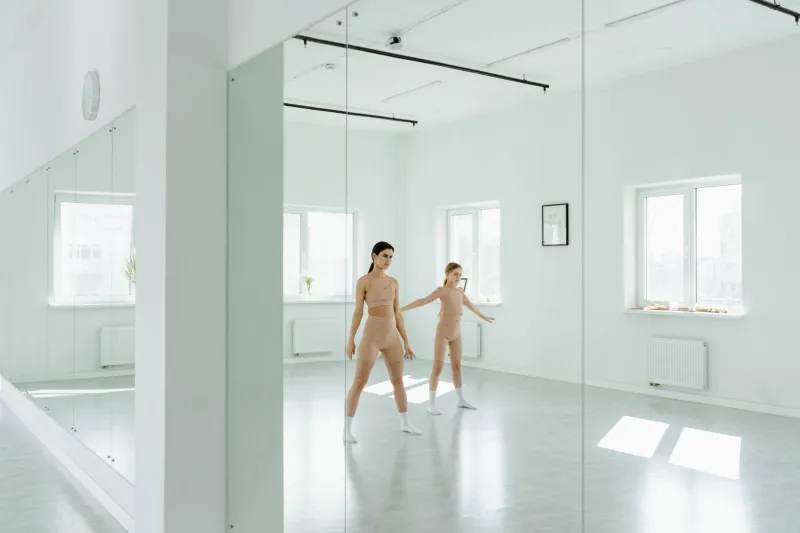
A rehearsal-room photo call is one of the strangest events in the dance calendar. The work is not ready, the light is not theatrical, and everyone is being asked to look as if they are mid-flow while a photographer circles the room. Dancers hold a shape for a fraction longer than the movement wants. A lift is repeated until the camera gets the line of the arm. Someone’s hair is adjusted. A jumper is removed because it reads badly on camera. None of this is dishonest, exactly, but it is a different kind of performance from the one the audience will see.
Choreographers often arrive at these sessions thinking about documentation. Marketing teams arrive thinking about choice. Those are not the same job. Documentation asks: what happened? Marketing asks: what is this work like, and can someone feel that in half a second while scrolling on a phone? The tension between those questions is where the real decisions get made.
What the venue sees before the work arrives
From a UK venue marketing perspective, the image has to do several jobs at once. It needs to work small, as a thumbnail on a listings page. It needs to work large, as a poster in a foyer. It needs to leave room for type. It needs to suggest energy without looking chaotic, intimacy without looking inaccessible, seriousness without looking worthy. That is a lot to ask of one frame.
Venue teams are not trying to flatten the work. They are trying to communicate it to people who may never have heard of the company. A programmer might know the choreographer’s history. A marketing officer might know the ticket-buying patterns. The image has to bridge those worlds. This is why the final choice is so often a compromise between the artist’s favourite shot and the image that reads fastest at a bus stop.
The frame as a promise
The most useful question is not whether an image is accurate. It is what kind of attention it invites. A photograph of a dancer mid-leap, limbs extended, may promise spectacle. A photograph of two dancers standing very close, almost still, may promise intensity. A photograph of an empty stage with one chair may promise atmosphere. None of these is wrong. But each one prepares the audience differently.
I have seen shows suffer because the image promised a speed and brightness the work did not deliver. I have also seen quiet, subtle work sold with a single, striking portrait that gave audiences permission to lean in. The image does not have to sum up the piece. It has to open a door. The trouble starts when the door leads somewhere the audience did not expect and no one has prepared them for the difference.
A practical checklist for choreographers
Before the photo call, decide what you are willing to let the camera invent. Talk to the photographer about the emotional temperature of the work, not just the movement vocabulary. Show them a section that contains the quality you want to sell, even if it is not the most photogenic section. Ask the marketing team which formats they need and whether there is room for more than one image across the campaign. A single poster image can sit alongside rehearsal shots and a short film; it does not have to carry everything alone.
During the shoot, give the photographer time to watch. Some of the best frames come after the staged moments, when everyone has relaxed and the movement starts to behave like itself again. Afterwards, resist the urge to choose only the shot that flatters the dancers. Choose the one that tells the truth sideways. The audience will forgive a great deal if the image has not lied to them about the weather.
The image after the image
A live work is not reducible to a picture, and that is exactly why the picture matters. It is the first choreography most people encounter. It sets the rhythm of expectation. In the 2026 season, with so much dance being browsed on small screens before it is ever seen on a stage, the still image has become part of the dramaturgy whether we like it or not.
So perhaps the useful shift is to stop treating the marketing image as an afterthought and start treating it as a scene. Ask what it is doing, who it is speaking to and what it leaves out. The poster is already dancing. The question is whether we have bothered to watch it.