The Agreed Room: Consent, Contact and the Quiet Architecture of a Rehearsal
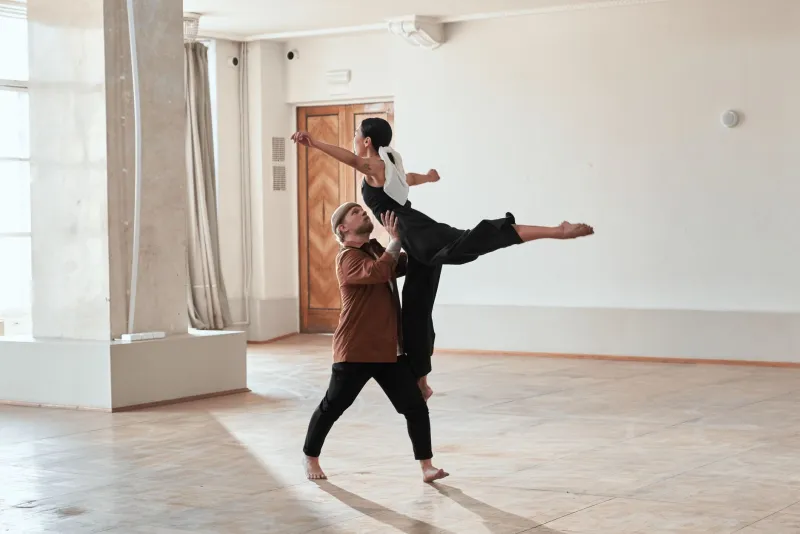
There is a moment, early in a contact rehearsal, when someone has to say the awkward thing out loud. It might be about a hand placement, a lift that has started to feel precarious, or the fact that yesterday's version of a phrase left a bruise. In the past, that moment was often handled with a shrug, a joke, or a silent decision to push on. Increasingly, it is being handled with language borrowed from theatre: a check-in, a boundary, a clearly stated agreement about what is on offer today.
Intimacy direction arrived in UK rehearsal rooms through screen and stage, largely in response to high-profile reckonings about power and consent in the performing arts. Its migration into dance was slower and, frankly, messier. Dance has always been a form built on touch. Contact improvisation, partnering, release work, the simple necessity of a choreographer moving a dancer's arm into place — these are not optional extras bolted onto the practice. They are the practice. So when a set of protocols designed for scripted intimacy scenes turns up in a studio, the question is not whether dance needs them. It is how they bend.
What Theatre Got Right
The most useful thing intimacy direction brought with it was not a form. It was a habit of explicit agreement. In theatre, an intimacy coordinator will typically work with performers to define the shape of a scene, agree on what is and is not permitted, and establish a way to signal discomfort or a wish to stop without derailing the room. Crucially, the agreement is revisited. What felt fine on Tuesday may not feel fine on Friday, and the protocol assumes that bodies, moods and circumstances change.
Dance has often relied on a kind of benevolent improvisation around consent — a trust that the room is decent, that the choreographer is kind, that a dancer will speak up if something is wrong. Mostly that trust is honoured. But it is not a system. It is a hope. The theatre model replaces hope with something a bit more durable, and that shift is quietly significant.
Where the Frameworks Creak
Then there is the awkward part. Intimacy protocols were largely written for narrative work: two characters, a scripted kiss, a clear beginning and end. Contemporary dance is often abstract, durational, and physically entangled in ways that resist a tidy scene-by-scene breakdown. How do you write a boundary document for a twenty-minute improvisation score that may involve lifting, rolling and landing on another person in ways nobody has yet imagined?
There is also a risk of over-formalising. A dancer who has spent years developing a wordless, intuitive rapport with a partner may find that rapport suddenly buried under consent forms and check-in scripts. The tenderness gets administered rather than felt. Some choreographers I have spoken with describe a version of this: the room becomes so carefully managed that the work loses its edge, its risk, the very thing that made it worth watching.
And there is a subtler problem, which is that consent practice can become a box-ticking exercise that protects institutions rather than people. A signed agreement means little if a dancer still feels unable to say no to the person who controls their contract. Language matters, but power matters more.
Building the Agreed Room
The choreographers getting this right seem to share a few instincts. They treat consent as a creative material rather than a compliance layer — something that shapes the work rather than limiting it. They build check-ins into the fabric of the day, not as an interruption but as part of the warm-up. They separate the conversation about boundaries from the conversation about casting and funding, so that a dancer's no carries no professional penalty. They keep the language plain. They let the agreement change.
One practical move that keeps coming up: naming the specific touch, out loud, before it happens. Not because the touch is dangerous, but because naming it turns an assumption into a decision. It also gives the partner something to respond to. Consent-led practice, done well, is not a brake on physical inventiveness. It is a second pair of eyes on it.
For those of us who work between projects and pick up rehearsals in borrowed halls with shifting casts, the challenge is consistency. A short tour may not have budget for an intimacy specialist. But the principles travel cheaply: ask before you place a hand, check in when the phrase changes, make stopping easy and unremarkable, and remember that the person in front of you is not a prop.
The Risk Worth Keeping
The fear that consent practice will sand down the art is understandable but, I think, misplaced. What it removes is not risk. It removes the particular dread of not knowing whether you can say no. The work can still be dangerous, tender, strange, unresolved. It just no longer has to be dangerous in the ways nobody agreed to.
The agreed room is not a softer room. It is a room where the difficult things can be attempted because the ground has been made steady first. That is not a retreat from choreography. It is choreography of a different kind — the choreography of how we treat each other while we make the thing.